Today, approximately half of the world’s population lives in urban areas (55 per cent). This figure is expected to rise dramatically: by 2050, the level of global urbanisation will reach 68 per cent. Almost the entirety of global population growth over the next thirty years will be absorbed by cities,1 meaning that nearly two billion additional people will live—almost exclusively—in metropolitan areas and megacities.
This demographic shift carries deep social, economic, and political consequences. The situation is especially critical in Asia, where megacities are at the forefront of future population growth. In these urban environments, rapid expansion risks amplifying long-standing structural contradictions—already shaped by social inequality, weak governance, and widespread informality—creating contexts where even the smallest disturbance can spiral out of control: a single spark can ignite a chain reaction comparable to a “Neronian fire,” spreading through the urban fabric and threatening national or regional security with ripple effects that extend far beyond the city itself.
Coastal Megacities and Compounded Urban Risks
When such cities are also coastal, they face double trouble. Coastal megacities are exposed not only to the pressures typical of large urban agglomerations, but also to the specific vulnerabilities of littoral environments.
The socio-economic dynamics in these settings are particularly complex. The coastline functions as an interface between the sea and the hinterland, absorbing the contradictions of both spaces—two worlds that are geographically close, yet structurally opposed. As a result, littoral megacities tend to concentrate multiple layers of risk.
- First, they are high environmental-risk areas, increasingly exposed to the collateral effects of global warming.
- Second, they are high criminal-risk areas, as their role as gateways between the inside and the outside makes them ideal hubs for illicit trafficking.
- Finally, they are high insurrectional-risk environments, shaped by the dense coexistence of different ethnic groups, religions, and institutional actors.
Jakarta: A Coastal Megacity at Risk
With over 11 million inhabitants, Jakarta exemplifies the challenges of coastal megacities in the Asia-Pacific region, combining in one city the vulnerabilities typical of these environments:
- Frequent floods and one of the fastest rates of land subsidence in the world are causing parts of the city to sink.2
- Informal settlements are expanding rapidly, often without access to clean drinking water or adequate sewerage systems.
- As a coastal city, Jakarta faces persistent problems of human trafficking, especially of women and children.
These interconnected problems make Jakarta not just a megacity at risk, but a lens through which we can understand how social, infrastructural, and environmental vulnerabilities converge in coastal urban areas.
Sea Level Rise, Floods, and Subsidence: Jakarta is Sinking
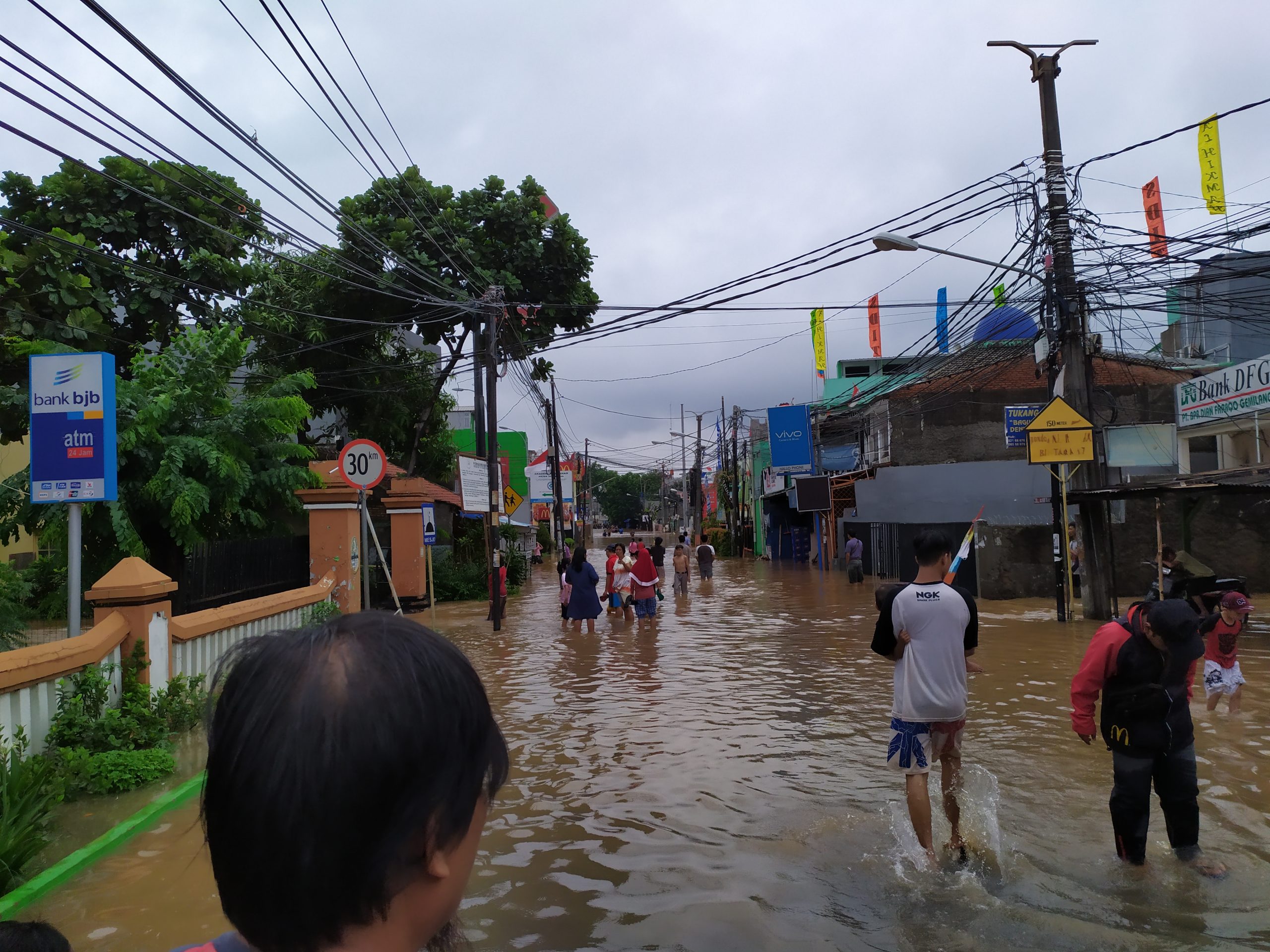
Jakarta’s northern districts face a triple environmental threat: rising sea levels, frequent flooding, and severe land subsidence. Many experts warn that the city’s fate is already precarious: up to 95% of its coastal areas could be submerged by 2050.
Sea level rise is primarily caused by the melting of the Greenland and Antarctic ice sheets, a direct consequence of global warming. A warmer atmosphere holds more moisture—about 7% more per 1°C of warming—triggering stronger storms and sudden floods. In Jakarta, tens of thousands of residents are forced to leave their homes annually, when waters can exceed two meters, rendering entire neighborhoods uninhabitable.
Subsidence further worsens the situation. North Jakarta has sunk by 2.5 meters over the past decade, with some areas continuing to sink 25 cm per year—faster than many other coastal megacities. The main cause is excessive groundwater extraction: around three-quarters of residents withdraw more than permitted for drinking, washing, and cooking. Limited access to safe tap water and high costs leave few alternatives.
Completely switching to alternative water sources—like rainwater, rivers, or reservoirs—would take years. According to specialist Heri Andreas, it would take roughly a decade to make all water sources safe. Meanwhile, Jakarta continues to sink, gradually taking on the characteristics of the legendary continent described by the Greek philosopher Plato in 330 B.C.: Atlantis.
Rapid urbanization and dense construction worsen these environmental stresses. The weight of countless buildings on already unstable ground accelerates subsidence, increasing risks for residents, infrastructure, and livelihoods.
The Slums of Jakarta
Extreme weather events, such as Indonesia’s worst floods since 2013, turn entire neighborhoods into rivers, sweeping away debris, cars, and even human remains. Losing a home means rebuilding in already overcrowded and precarious areas.
The story of Neng, a 14-year-old girl living in Jakarta, illustrates the harsh realities faced by many slum residents. She lives in Jembatan Besi, one of the city’s poorest and most densely populated informal settlements, where sunlight is largely blocked by tall buildings, leaving streets lit only by hanging neon lamps. Neng left school to help at her family’s food stall and a small t-shirt factory, joining the ranks of child laborers. Just a few kilometers away, luxury shopping malls with pools and gardens starkly highlight the socioeconomic divide.
Jakarta’s wealth gap has widened significantly over the past two decades: the four richest individuals now own more wealth than the poorest 100 million people in the country. Half the population lives in informal settlements, often in precarious dwellings made of unstable materials and with low ceilings.
Child Trafficking and Sexual Exploitation in Jakarta
Layered on top of environmental and infrastructural issues is the problem of child trafficking3 and sexual exploitation. Exploiters target the poorest, least educated, and most socially isolated children, often from slums, and families may consent to selling them without knowing their fate.
Exploitation takes many forms: prostitution, forced labor in factories, and slavery. Demand for young workers persists both locally and abroad; Japan and Malaysia are among the destinations, demonstrating how Jakarta’s coastal position facilitates maritime trafficking routes.
Reliable data are scarce due to the illegal nature of the market. According to 2008 International Labour Organization data, over 180,000 children aged 5 to 17 were engaged in sex work nationwide, with 80% of working girls in Jakarta nightclubs providing sexual services.4 Even when not deceived or coerced, children have little choice because extreme family poverty leaves no alternatives.
One story humanizes these numbers. Erma, a 15-year-old girl from West Java, was brought to Jakarta by her uncle and sold to a friend. Promised work as a waitress, she was soon exploited in public spaces to pay her pimp—losing her childhood in the process.5
Conclusion
Few cities in the world are as vulnerable as Jakarta. Its fate seems sealed: its coastal location exposes the city to flooding and subsidence, while widespread poverty amplifies the risks, affecting millions of residents living in slums.
The twenty kilometers of cement walls built over the past three years offer only temporary relief. What’s needed are structured solutions, not quick fixes.
Only 2% of households in central Jakarta are connected to the public sewer system. All others rely on septic tanks that leak directly into streets, rivers, and fields. A modern sewer system would not solve everything, but it could drain stormwater, prevent flooding, and protect groundwater. Contaminated water also spreads diseases like typhoid, which propagate rapidly in overcrowded and unsanitary slum conditions.
The weight of thousands of buildings on already unstable ground accelerates subsidence, worsening floods and infrastructure failures. Every day, Jakarta moves closer to becoming a modern Atlantis—a city myth born at the intersection of natural forces and human choices.
Much of the city’s future, experts warn, is already written. Without structural changes, vast areas could be submerged by 2050. The Indonesian Parliament has already decided: the capital will move to Nusantara. Yet Jakarta remains at the heart of the crisis.
It’s not just the city that suffers. The entire nation will pay the price. Overcrowding, migration from uninhabitable areas, and dwindling resources all threaten social cohesion and national security. Under these conditions, the risk of insurrections rises.6 Human security—locally, nationally, and even internationally—is at stake.
Jakarta is sinking. Not just into the sea, but into a complex web of social, infrastructural, and environmental crises. Its story is a warning. Coastal megacities around the world must act now: climate adaptation, social equity, and infrastructural resilience are imperative. Otherwise, what is happening here today could happen elsewhere tomorrow.
- World Population Prospect 2019, UN, 2019
- JAKARTA. Urban Challenges in a Changing Climate. Mayors’ Task Force On Climate Change, Disaster Risk & The Urban Poor, The World Bank, 2010
- Trafficking is defined under the UN Trafficking Protocol supplementing the Convention against Transnational Organized Crime
- REPORTAGE Child Labor Around us 2012, AJI, ILO, 2012, p. 37
- Child trafficking for prostitution in Jakarta and West Java: a rapid assessment, ILO, 2004
- P. Foradori, G. Giacomello, Sicurezza globale. Le nuove minacce, il Mulino, Bologna, 2014, p. 84