
In the 21st century, global competition is no longer just about oil and gas – it’s about wheat, water, and weather. The food system is under unprecedented pressure: conflict, climate, and supply chain shocks are driving food insecurity to record levels. According to FAO, 733 million people experienced hunger in 2023, while food production must grow by at least 60% by 2050 to meet global demand. This is no longer just a humanitarian issue – it is a geopolitical one. Food is becoming the new oil.
By Aidarbek Khojanazarov*
And in this new era, Kazakhstan is quietly repositioning itself as a pragmatic, neutral, and increasingly strategic food supplier – a landlocked nation turning foodlocked, and one that may well become part of the answer to the global imbalance in agricultural security.
A Sleeping Giant Awakens
With 180 million hectares of agricultural land – of which more than 75% is arable – Kazakhstan is among the most resource-rich countries in terms of farming potential. It ranks in the top 10 global wheat exporters, and in 2023, exported 9.2 million tonnes of grain. Flour exports rose by 20%, while oilseed processing added $400 million to national revenues. But the story is no longer just about raw commodities. Kazakhstan is deliberately moving toward value-added agri-production and building institutional capacity to support a full agribusiness transformation.
In 2024 alone, public investment in agriculture exceeded $500 million, including subsidies, irrigation development, tax incentives, and digital monitoring systems. According to the Ministry of Agriculture, average crop yields in key regions have increased by 15% over the past decade. A national network of grain reserves and procurement mechanisms has helped stabilize market prices and improve farmer incomes.
Kazakhstan’s Quiet Food Diplomacy
Where others rely on megaphone diplomacy, Kazakhstan is forging a quieter path – one rooted in pragmatism, resilience, and logistical ingenuity. In 2024, Kazakhstan supplied one-third of all grain purchases made by the Islamic Organization for Food Security (IOFS), primarily via long-term contracts that brought in over $400 million. This positions Kazakhstan not just as a seller, but as a strategic guarantor of food reserves for the Muslim world.
This emerging role is no accident. Kazakhstan has deepened cooperation with the UN FAO, World Food Programme (WFP), and the Islamic Development Bank, aligning itself with global efforts to build transparent and resilient food systems. At the national level, agricultural transformation has been defined as central to Kazakhstan’s economic sustainability.
In a world fragmented by war and distrust, Kazakhstan is leveraging its “quiet food diplomacy” to gain new influence. When a container of Kazakh wheat arrives in Karachi or Dubai, it has crossed deserts, dodged broken corridors, and reconnected fractured markets. These routes – once overlooked – are becoming new arteries of global resilience.
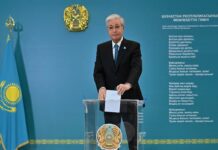
In his latest State of the Nation Address, President Kassym-Jomart Tokayev emphasized that the agribusiness sector must become one of Kazakhstan’s key drivers of growth. This reflects a deliberate policy shift: Kazakhstan aims not only to remain a top grain exporter, but also to develop value-added production. Support for farmers, investment in irrigation and digitalization, and a stronger focus on sustainability align closely with the EU’s Green Deal priorities and create new opportunities for partnership.
A Strategic Comparison: Why Kazakhstan?
One may ask: why Kazakhstan and not, say, Australia or Canada? The answer lies in geography, neutrality, and adaptability.
Geography: Unlike maritime exporters, Kazakhstan bridges Central Asia, the Middle East, and China. It anchors the Trans-Caspian route, a critical alternative to the disrupted Black Sea corridor. Exports to Xinjiang, China rose 60% in 2024 alone, while routes through Iran now provide access to India and Pakistan.
Neutrality: Kazakhstan’s foreign policy is balanced and non-confrontational – a vital asset in polarized times. While Australia and Canada are increasingly entangled in geopolitical blocs, Kazakhstan offers a neutral, stable, and pragmatic alternative.
Agility: Kazakhstan is willing to adapt. State-owned procurement agencies once considered Soviet relics now act as market stabilizers. Farmers gain predictable prices, and importers gain dependable supply.
According to OECD assessments, countries that can ensure food transparency and avoid export bans will become preferred partners in future food deals. Kazakhstan is actively moving in that direction.
Infrastructure: The Bottleneck and the Breakthrough
Kazakhstan’s potential is real – but so are its constraints. Port capacity in Aktau and Kuryk is limited to 3 million tonnes annually, whereas demand exceeds 7 million. Trans-Caspian transport costs reach $80 per tonne, reducing competitiveness versus Russian or Turkish grain.
Yet investment here could unlock exponential returns. Experts estimate that $700 million in infrastructure modernization could yield $500 million in annual revenue. Moreover, climate volatility already causes up to 10% crop loss in dry years, underlining the need for crop insurance schemes and price stabilization funds – both currently in development.
From Landlocked to Foodlocked
Kazakhstan’s agricultural rise is not a short-term pivot, but a long-term strategy. The country is integrating more deeply with platforms of the EU, China, and the Organisation of Islamic Cooperation. With consistent investment and modernization, Kazakhstan could evolve into the backbone logistics hub for food distribution across Eurasia.
In an increasingly divided world, where trust is scarce and food insecurity is rising, Kazakhstan is not just a supplier – it can be a stabilizing force. Its quiet food diplomacy offers an example of how middle powers can lead not with dominance, but with reliability.
And in this new race – where wheat may matter more than oil – Kazakhstan is a country worth watching.
 Aidarbek Khojanazarov is the chairman of the Respublica Party, which has entered parliament and is one of the influential political forces in the Mazhilis. He is a member of the Committee on Agrarian Issues of the Mazhilis. Previously, he served as Chairman of the Board of JSC National Managing Holding KazAgro. He also worked as Chief Executive Officer of OlzhaAgro, one of the largest agro-industrial holdings in Kazakhstan, encompassing a network of production and processing companies. Mr. Khojanazarov is a seasoned entrepreneur with extensive experience in agribusiness and national economic development.