Nuclear cooperation between Hanoi and Moscow: energy security, economic development, and geopolitical balancing.
Edited by Federica Masellis
Immediate context
The signing of the agreement between Vietnam and the Russian Federation for the construction of the Ninh Thuan 1 nuclear power plant, which took place in March 2026 during Vietnamese Prime Minister Pham Minh Chinh’s official visit to Moscow, forms part of a political and energy trajectory already outlined by Hanoi in recent years. Far from being a short-term response, the decision reflects a structural strategy aimed at supporting economic growth through the strengthening of energy security.
As early as November 2024, the Vietnamese government had announced the resumption of the nuclear programme, previously suspended in 2016, highlighting the need to ensure national energy security against a backdrop of rapidly growing demand.[1] Official projections indeed indicate a significant increase in electricity demand in the medium to long term, linked to the country’s rapid economic development.[2]
At the same time, Vietnam’s national planning has set long-term objectives aimed at transforming the country into a high-income economy by 2050, directly linking the energy issue to industrial development strategies[3] In this context, nuclear power is emerging as an increasingly important component of the national energy mix.
The International Atomic Energy Agency has also confirmed that Vietnam is developing the infrastructure necessary to support a civil nuclear programme, progressively integrating it into national energy planning.[4] The immediate context of the agreement with Russia is therefore that of a decision already taken at the political and institutional level, now translated into a concrete technological partnership.
The news
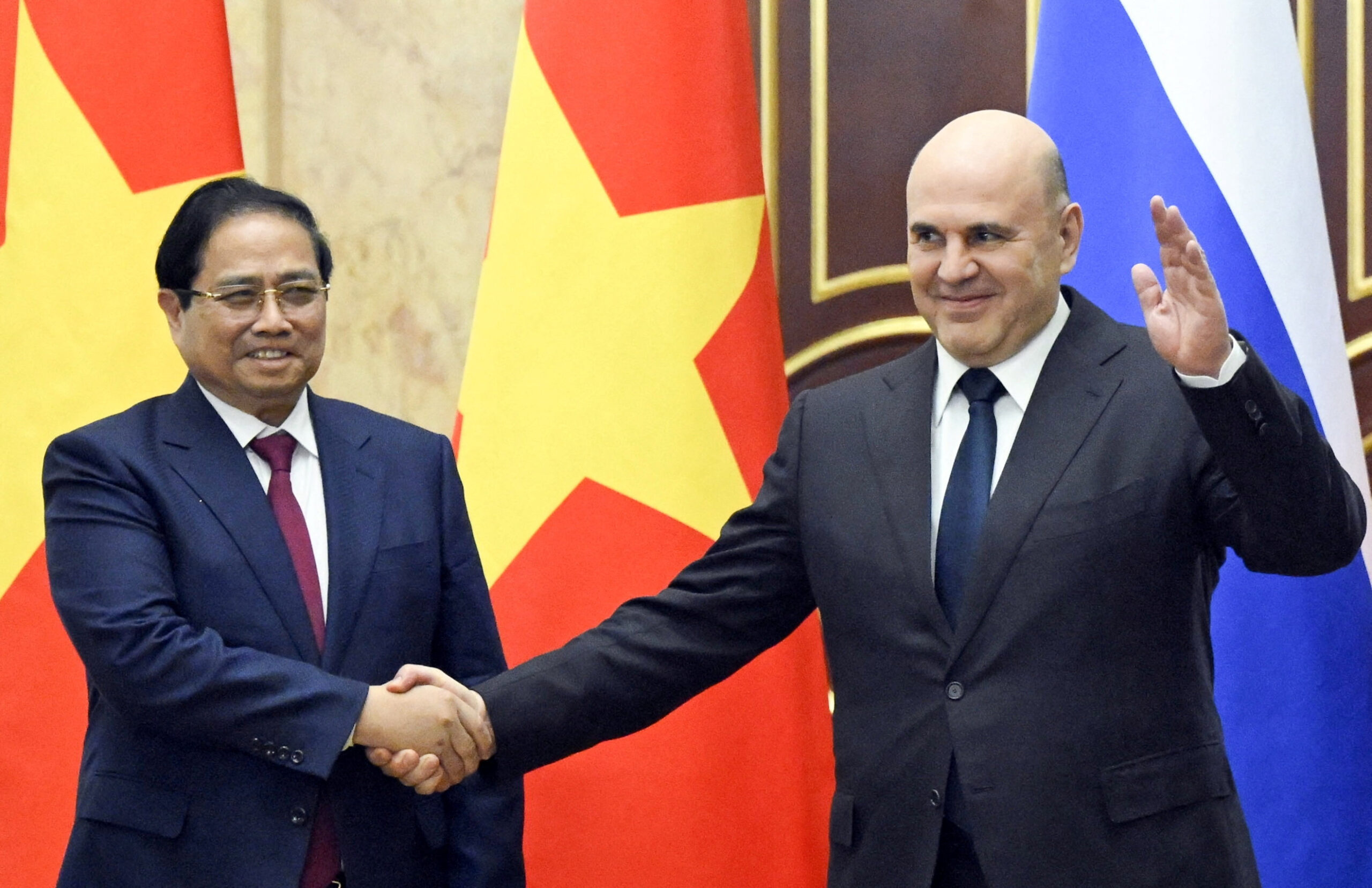
The agreement between Vietnam and the Russian Federation for the construction of the Ninh Thuan 1 nuclear power plant was formalised during the official visit of Vietnamese Prime Minister Pham Minh Chinh to Moscow, where he met his Russian counterpart Mikhail Mishustin.[5] The agreement provides for the construction of two nuclear reactors using Russian VVER-1200 technology, with a total installed capacity of approximately 2,400 megawatts, to be carried out by the Russian state-owned company Rosatom.[6]
According to the official Vietnamese statement, the agreement is not limited to the construction of the plant but includes broader cooperation in the fields of science, technology and staff training, outlining a long-term partnership between the two countries.[7] At the same time, the Russian authorities presented the project as part of an overall strengthening of bilateral relations, also including cooperation in the energy, technology and infrastructure sectors.[8]
The agreement comes against a backdrop of growing pressure on Vietnam’s energy system. In recent years, rising domestic demand and the volatility of international energy markets have prompted Hanoi to diversify its supply sources and reduce its dependence on fossil fuels.[9] In this context, nuclear power is once again being considered as a stable, long-term solution to support economic growth.
Interpretation and strategic implications
The agreement between Vietnam and the Russian Federation for the construction of the Ninh Thuan 1 nuclear power plant cannot be interpreted solely as an energy decision. Rather, it reflects a strategic choice that combines energy security needs, economic development objectives and broader geopolitical considerations.
Firstly, the return to nuclear power signals Hanoi’s desire to reduce the vulnerability arising from dependence on traditional energy sources and fluctuations in international markets, evident in the context of recent tensions over global energy routes. In particular, the dynamics linked to the Strait of Hormuz – through which a significant proportion of the world’s oil trade passes – have highlighted the vulnerability of Asian economies to supply shocks and price volatility.[10] In this sense, nuclear power represents a solution that allows for the stabilisation of energy production in the long term, helping to support a rapidly expanding economy.[11] This choice forms part of a broader strategy of diversifying the energy mix and long-term planning.
At the same time, the nature of cooperation with Russia suggests that the project has implications that go beyond the economic dimension. As also highlighted in the literature, civil nuclear cooperation tends to create long-term structural relationships between the supplier country and the recipient country, as it involves technology transfer, staff training and operational dependence throughout the entire life cycle of the plant.[12] In this context, Rosatom’s role emerges not only as a technology supplier, but as an actor capable of consolidating Russia’s presence in international energy markets even in a context of sanctions.[13] In this sense, nuclear cooperation can be seen as a tool for projecting influence, through which Russia builds long-term relationships based on critical infrastructure, as demonstrated by projects launched in countries such as Bangladesh (the Rooppur plant) or Turkey (the Akkuyu plant), characterised by cooperation models that include financing, construction and operational management by the Russian side.[14]
From a geopolitical perspective, the agreement also reflects a balancing strategy on the part of Vietnam. Hanoi traditionally maintains a foreign policy characterised by the diversification of partnerships and the careful management of relations with major powers. In this context, cooperation with Russia in the nuclear sector allows Vietnam to strengthen its strategic autonomy without compromising relations with other regional and global actors.
Finally, the project forms part of a broader regional dynamic, in which several Southeast Asian countries are re-evaluating nuclear power as an alternative to fossil fuels. This trend is driven both by the need to sustain economic growth and by the requirement to reduce emissions, making nuclear power an increasingly significant component of the region’s energy strategies.
Possible scenarios
The agreement between Vietnam and Russia opens the door to a series of developments that go beyond the bilateral dimension and will depend on the evolution of the international energy and geopolitical context.
A first scenario is that of a smooth and successful implementation of the project, in which the Ninh Thuan 1 plant becomes a pillar of Vietnam’s energy security. In this case, nuclear power would contribute significantly to stabilising electricity generation and supporting economic growth, whilst strengthening technological cooperation with Russia.[15] This scenario, however, presupposes political stability, the financial sustainability of the project and the absence of disruptions in supply chains.
A second scenario, however, concerns a growing structural dependence on Russia. The very nature of nuclear cooperation – which encompasses technology, fuel and operational support – could cement an asymmetrical relationship between Hanoi and Moscow in the long term.[16] In an international context marked by sanctions and geopolitical tensions, this could expose Vietnam to indirect risks, limiting its strategic room for manoeuvre. Finally, a third scenario is that of strategic diversification on Vietnam’s part. In line with its traditional foreign policy, Hanoi could use the agreement with Russia as a negotiating lever, whilst maintaining openness towards other international partners in the energy sector. This would allow it to balance the benefits of cooperation with Moscow against the need to avoid excessive dependence on a single actor.
Conclusion
Overall, the agreement for the construction of the Ninh Thuan 1 nuclear power plant represents a significant step in Vietnam’s energy and geopolitical strategy. It reflects a long-term choice that intertwines energy security, economic development and the management of international relations.
Beyond its technical aspects, the project highlights how civil nuclear power can become a tool for strategic projection and the building of structural relations between states. At the same time, it presents Vietnam with the need to balance the benefits of cooperation against the risks associated with growing technological and political interdependence.
In this sense, the significance of the agreement lies not only in the construction of energy infrastructure, but in its capacity to redefine, at least in part, Vietnam’s strategic positioning within the international system.
Note
[1] Government of Vietnam, “Vietnam to Restart Ninh Thuan Nuclear Power Project”, Government News, 2024, accessed 26 April 2024, https://en.baochinhphu.vn/viet-nam-to-restart-ninh-thuan-nuclear-power-project-111241130191949533.htm
[2] Ibid.
[3] Government of Vietnam, “National Green Growth Strategy for 2021–2030, vision towards 2050”, Government News, 2021, accessed 26 April 2023, https://en.baochinhphu.vn/national-green-growth-strategy-for-2021-2030-vision-towards-2050-11142515.htm.
[4] International Atomic Energy Agency, “IAEA Reviews Vietnam’s Nuclear Power Infrastructure Development,” IAEA, 2025, accessed 26 April 2023, https://www.iaea.org/newscenter/pressreleases/iaea-reviews-viet-nams-nuclear-power-infrastructure-development.
[5] Ministry of Industry and Trade of Vietnam, “Vietnam and Russia Officially Commit to Nuclear Power Development”, MOIT, 2026, accessed 26 April 2023, https://moit.gov.vn/en/news/vietnam-and-russia-officially-commit-to-nuclear-power-development.html.
[6] Rosatom State Atomic Energy Corporation, Annual Report 2022 (Moscow: Rosatom, 2022), https://report.rosatom.ru/go_eng/go_rosatom_eng_2022/rosatom_2022_eng.pdf. [7] Ministry of Industry and Trade of Vietnam, “Vietnam and Russia Officially Commit to Nuclear Power Development.”
[8] Government of the Russian Federation, “Meeting between Mikhail Mishustin and Prime Minister of Vietnam Pham Minh Chinh,” Government.ru, 2026, accessed 03/04/26, http://government.ru/en/news/58147/.
[9] International Atomic Energy Agency, “IAEA Reviews Vietnam’s Nuclear Power Infrastructure Development.”
[10] U.S. Energy Information Administration, “World oil transit chokepoints play an important role in global energy security,” Today in Energy, 2024, accessed 10/04/2026, https://www.eia.gov/todayinenergy/detail.php?id=61002.
[11] Ministry of Industry and Trade of Vietnam, “Vietnam and Russia Officially Commit to Nuclear Power Development.”
[12] Murina, “International Cooperation of the State Atomic Energy Corporation ROSATOM under Sanctions,” RUDN Journal of Economics 32, no. 3 (2024): 470–488, https://doi.org/10.22363/2313-2329-2024-32-3-470-488, https://doaj.org/article/8330607815d643c2985a6989d4cff9a2.
[13] Rosatom State Atomic Energy Corporation, Annual Report 2022.
[14] Ibid.
[15] Ministry of Industry and Trade of Vietnam, “Vietnam and Russia Officially Commit to Nuclear Power Development.”
[16] Murina, “International Cooperation of the State Atomic Energy Corporation ROSATOM under Sanctions.”
Photo: Autore: Alexander Miridonov | Russian Prime Minister Mikhail Mishustin and Vietnamese Prime Minister Pham Minh Chinh take part in a signing ceremony of an agreement on cooperation in the construction of a nuclear power plant on the territory of Vietnam, in Moscow, Russia, March 23, 2026. Sputnik/Alexander Miridonov/Pool via REUTERS