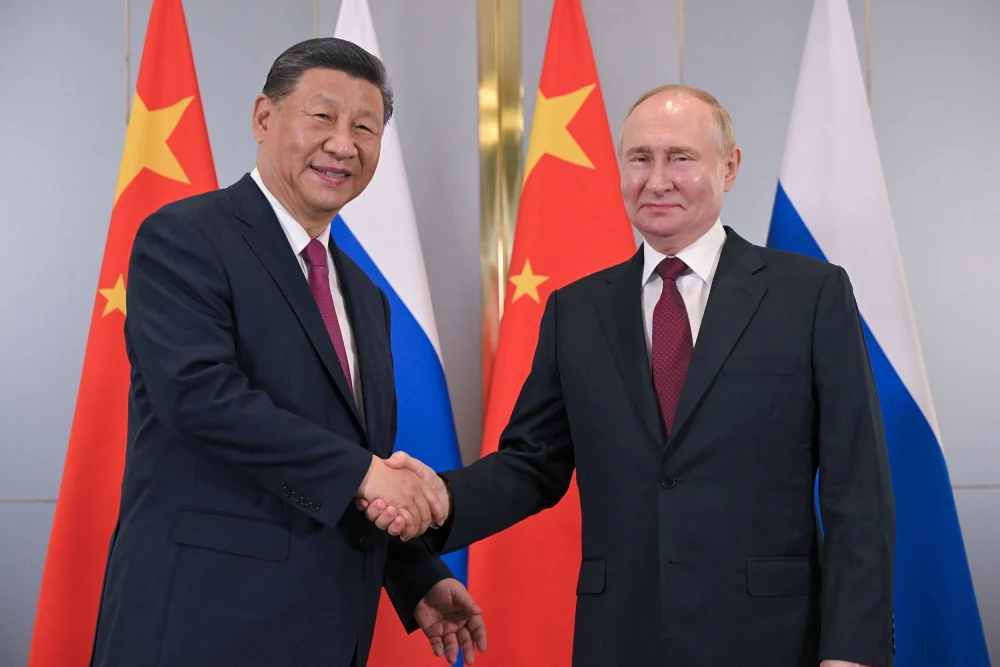
On the 4th of February, Xi Jinping and Vladimir Putin met in videoconference, on the occasion of the Beginning of Spring on the Chinese calendar, to outline their partnership plans for the new year. An analysis of the Chinese pros and cons in supporting Russia.
By Francesca Pistone
On the 4th of February, Xi Jinping and Vladimir Putin met in videoconference, on the occasion of the Beginning of Spring (立春, lìchūn) on the Chinese calendar, to outline their partnership plans for the new year[1] [2].
A tight partnership
The two countries have now established a tradition in meeting at the beginning of the year, demonstrating their close political and economic partnership. Sharing similar geopolitical views, the two countries have naturally aligned and developed economic and political ties through bilateral agreements and multilateral organizations as the BRICS and the Shanghai Cooperation Organization. Additionally, since the start of the war in Ukraine in 2022, China has provided crucial support to Russia militarily, diplomatically and economically by filling the vacuum left by European firms[3] [4].
The content of the call
During the meeting, the China-Russia economic and political alignment was made evident. Referring to the goals of 2025, Putin referred to the celebrations of the 80th anniversary of the victory in World War II, the Tianjin summit, their two talks in Moscow and Beijing, and celebrated the continuation of their economic cooperation. He concluded touching on the humanitarian exchanges of the cross years of culture.
Regarding the new year, Putin remembered the beginning of the cross-years of education of Chinese and Russian students and his appreciation for the visa-free travel initiative. Turning to international affairs, Putin referred to Moscow and Beijing relations as fundamental stabilizing factors in the current turbulent times and expressed his willingness to continue even closer coordination both bilaterally and through multilateral frameworks as the UN, BRICS and the Shanghai Cooperation Organization.
However, Putin stressed his desire to reaffirm their joint efforts to ensure the sovereignty and security of their countries and the right to choose their own development path[5]. Seemingly, Xi Jinping called himself satisfied with 2025 relations, but stressed the need to ensure that the bilateral relations with Russia will continue to develop through deeper strategic coordination and a more proactive assumption of major-power responsibilities of major countries. The two should work to maintain strategic stability internationally and Russia has the obligation to encourage the international community to uphold fairness and justice, firmly safeguard the victorious outcomes of World War II, the UN-centered international system, and the basic norms of international law, he said[6].
The dialogue highlights both the strong linkages but also the different necessities and expectations of both heads of state. For Putin, the priority is to secure support in negotiations over Ukraine, but for Xi is mainly to maintain strategic stability internationally. This difference made the international community question the willingness of China to support Putin’s Russia “without limits”, especially in light of growing economic, strategic and reputational costs that this could mean for Beijing[7] [8] .
Why China supports Russia
What Beijing gives to the Kremlin is a strategic, discreet, and well-coordinated behind-the-scenes support, that is not necessarily an unlimited one.
Firstly, as said previously, the alliance between the two originates from a common geopolitical view opposing the United States as a global leader and the influence of democracy. Therefore, Russia supported China in its trade war with Washington[9], and now Xi is repaying the favor by supporting Russia in Ukraine against the aggressiveness of the West, as Putin portrays it[10]. This is proved as well by remark of Chinese Foreign Minister Wang Yi’s to the EU Commission in the summer of 2025, “China cannot afford to see Russia losing in Ukraine[11]”.
However, Xi support is not only ideologically driven, instead presents mostly pragmatic elements. If Putin loses in Ukraine, the Russian regime will be strongly weakened, in its anti-western ideology, surrounded by NATO and EU influence at its borders and destabilized by the secessionist movements[12]. This will deprive Xi Jinping of a strong bulwark in Eurasia allied in his anti US hegemony world order, especially in light of a future military intervention in Taiwan. Putin’s China-friendly regime is also fundamental to ensure security and stability along the 4200 kilometers border that they share.
Secondly, while China has been fundamental for both exports and imports for the Kremlin, to the point where it is undermining Putin’s economic leverage and its strategic flexibility, Russia is also important economically for China, in particular to absorb its exports[13]. While leveraging its trade relations in order to not expose itself too much[14], China found in the Russian market a source of diversified energy supply (reducing its previous reliance on Angola and Saudi Arabia) and a solution to its weak domestic demand problem[15].
In fact, the great economic expansion goals achieved by Beijing are based on intense exports of goods abroad that would not be bought domestically. China has spent decades building an economic capacity that transformed itself into an almost completely economically self-reliant country. However, the overproducing Chinese companies rely on foreign markets due to their weak national consumer spending, which has not yet rebounded from the collapse experienced during Covid. Chinese leaders have tried to fuel public confidence to enhance domestic driven growth, but for now their attempts have been unsuccessful[16]. In the meantime it is important for China to continue exploiting foreign demand also from Russia.
What are the costs that China is paying for its support?
Xi’s main objective for 2026, as many other countries including the US and the European Union, is to enhance economic stability and security in an increasingly unstable world. As the senior research fellow on China in the Asia-Pacific Programme at Chatham House Dr. Yu Jie said “The rest of the world worries about supply chains that China may cut it off, but I think equally China is worrying about its own supply chains”[17].
This goal, in addition to the omnipresent interest driven approach in Chinese foreign policy calculations, makes China very sensitive to external pressures, such as economic sanctions and reputational costs[18].
Therefore, while maintaining its posture abroad, Xi Jinping needs to prudently evaluate the implications of its foreign relations on its international trade plans. His support to Putin might hinder important economic relations, such as the one with European countries.
While China remains a very self-reliant country as referred previously, it still conducts key trade relations with Europe. In 2024, the European Union exported the equivalent of 30% of the total Chinese supply of dual-use products, according to EUISS calculations of China Customs statistics[19]. Therefore, Xi’s approach to future relations with Russia, might be influenced by his commitment to not worsen the already complicated dialogue with the EU. Supporting Russia, might also have reputational costs for Beijing in the Plural South, due to the unrespected commitment to up-hold territorial sovereignty as principle of international law on which their alignment is based. A loss in economic and strategic relations with these countries will be devastating for the Dragon’s foreign policy.
A possible arm in European hands
While a rupture between China and Russia is not probable in the near future, still these data on the conditional support of Beijing can serve for strategic actions of the EU. Russia now strongly depends on Chinese support in order to sustain the military and economic pressures coming from the West and even a reduction of such assistance might make a difference in Ukraine negotiations.
To enhance its security, the EU should exploit this knowledge and adopt more measures that increase the economic and diplomatic costs that China incurs for supporting Russia[20].
Note
[1] President of Russia; Videoconference with President of China Xi Jinping; February 4,2026. In: http://en.kremlin.ru/events/president/news/79098
[2] Xinhua; Xi calls on China, Russia to grow ties, work for global strategic stability; February 4, 2026. In: https://english.news.cn/20260204/ac95c216d7d349a3961b589c13d6e8d6/c.html
[3] European Union Institute for Security Studies; The dependence gap in Russia-China relations; October 2,2025. In: https://www.iss.europa.eu/publications/analysis/dependence-gap-russia-china-relations
[4] European Union Institute for Security Studies; Unpowering Russia: How the EU can counter and undermine the Kremlin; May 2025. In:https://www.iss.europa.eu/sites/default/files/2025-05/CP_186.pdf
[5] President of Russia; Videoconference with President of China Xi Jinping; February 4,2026. In: http://en.kremlin.ru/events/president/news/79098
[6] Xinhua; Xi calls on China, Russia to grow ties, work for global strategic stability; February 4, 2026. In: https://english.news.cn/20260204/ac95c216d7d349a3961b589c13d6e8d6/c.html
[7] Internationale Politik Quarterly; China’s Complex Relations with Russia: Tracing the Limits of a “Limitless Friendship”; Una Berzina-Cerenkova and Tim Rühlig; September 12, 2023. In: https://ip-quarterly.com/en/chinas-complex-relations-russia-tracing-limits-limitless-friendship
[8] European Union Institute for Security Studies; The dependence gap in Russia-China relations; October 2,2025. In: https://www.iss.europa.eu/publications/analysis/dependence-gap-russia-china-relations
[9] Internationale Politik Quarterly; China’s Complex Relations with Russia: Tracing the Limits of a “Limitless Friendship”; Una Berzina-Cerenkova and Tim Rühlig; September 12, 2023. In: https://ip-quarterly.com/en/chinas-complex-relations-russia-tracing-limits-limitless-friendship
[10] European Union Institute for Security Studies; Unpowering Russia: How the EU can counter and undermine the Kremlin; Pag. 16; May 2025. In:https://www.iss.europa.eu/sites/default/files/2025-05/CP_186.pdf
[11] China Observers in Central and Eastern Europe; China’s Strategic Outlook on Ukraine and Global Equilibrium : A Dive into Beijing’s Pro Russia Neutrality; Emanuele Rossi, Enrico Maria Ferdella; August 28, 2025. In: https://chinaobservers.eu/chinas-strategic-outlook-on-ukraine-and-global-equilibrium-a-dive-into-beijings-pro-russian-neutrality/
[12] European Union Institute for Security Studies; Unpowering Russia: How the EU can counter and undermine the Kremlin; Pag. 18; May 2025. In:https://www.iss.europa.eu/sites/default/files/2025-05/CP_186.pdf
[13] European Union Institute for Security Studies; The dependence gap in Russia-China relations; October 2,2025. In: https://www.iss.europa.eu/publications/analysis/dependence-gap-russia-china-relations
[14] Chatham House; What is China’s vision for a new world order?; James Kynge; January 23, 2026. In: https://www.chathamhouse.org/events/all/standard-event/what-chinas-vision-new-world-order
[15] Mercator Institute for China Studies; China’s overcapacity threatens to reshuffle global industrial bases; February 10, 2026. In: https://merics.org/en/comment/chinas-overcapacity-threatens-reshuffle-global-industrial-bases
[16] Euronews; China hits 5% growth goal, but weak demand tells another story; January 19,2026. In: https://www.euronews.com/business/2026/01/19/china-hits-5-growth-goal-but-weak-demand-tells-another-story
[17] Chatham House; What is China’s vision for a new world order?; Yu Jie; January 23, 2026. In: https://www.chathamhouse.org/events/all/standard-event/what-chinas-vision-new-world-order
[18] European Union Institute for Security Studies; Unpowering Russia: How the EU can counter and undermine the Kremlin; Pag. 20; May 2025. In:https://www.iss.europa.eu/sites/default/files/2025-05/CP_186.pdf
[19] European Union Institute for Security Studies; The dependence gap in Russia-China relations; October 2,2025. In: https://www.iss.europa.eu/publications/analysis/dependence-gap-russia-china-relations [20] European Union Institute for Security Studies; Unpowering Russia: How the EU can counter and undermine the Kremlin; Pag. 22; May 2025. In:https://www.iss.europa.eu/sites/default/files/2025-05/CP_186.pdf
Photo: Putin and Xi Jinping