
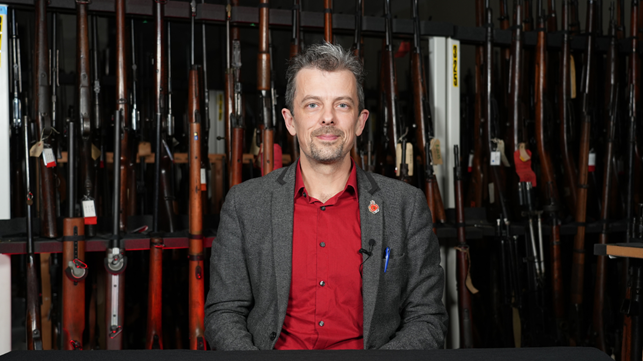
Interview with Jonathan Ferguson, Keeper of Firearms & Artillery at the Royal Armouries Museum in the UK and author of several publications on the subject.
By Andrea Minervini and Paolo Mauri
The aesthetics of weaponry can be a controversial subject, primarily because these objects are thinked and designed for destruction and to take lives. Nonetheless, an aesthetic dimension remains present, both historically and in the modern era, as peoples developed preferences regarding the design of arms and armours. How much significance does this aesthetic component hold throughout the various stages of the arms market? Is it as influential as functionality? To explore these questions and provide a deeper analysis of this complex theme, we spoke with an expert, Jonathan Ferguson, Keeper of Firearms & Artillery at the Royal Armouries Museum in the UK and author of several publications on the subject.
Questions:
Why are some people fascinated by weapons? Is there – or has there been – a purely aesthetic component to the instruments of war? If so, what can you tell us about it?
«Never purely aesthetic – any applied art by definition retains its practical functional if only in theory. A gold-plated gun still shoots, a beautifully carved and inlaid hunting gun is still intended to be useful in the hunt. There has been an aesthetic component since almost the beginning – see our so-called ‘Danzig gun’ circa 1400CE which features several human face cast into it for decorative and perhaps symbolic purposes. Our very field of ‘arms and armour’ originates as essentially an art historical discipline arising from the collecting communities of the 19th century (the Metropolitan Museum of Art in New York is a good example of this – they display nothing later than the 1870s as their focus is on the craft and art of it all). They studied the typology of weapons and armour for their offensive/defensive roles, but they always favoured beautifully designed, made, and decorated items. And of course, even non-decorated arms and armour objects are still appreciated for their design and craftsmanship, especially those crafted or at least finished by hand. Mass-produced functional weapons are appreciated more for their design and engineering. So I’d say art, design and technology – and all the people involved in those activities – are the basis of our subject with the objects as the tangible material culture at its heart.
As to why the fascination, beyond aesthetics I think anything capable of taking a life is intrinsically interesting and/or scary to people. Armour is interesting for its protective properties but also as costume/fashion. Some are fascinated by design and technology (pretty or ugly/functional) whether planes, trains, automobiles – or weapons».
Some types of weaponry – such as the Soviet/Russian “AK” series – have become iconic and recognizable all over the world. What is the reason for this? Could the attempt to preserve its symbolic silhouette be an important factor in the development phase as instrument for other types of “advantages”?
«The primary reason is that more of this type were made than any other rifle in history, and many were sold cheaply, given away, or licenced for production by the Soviet Union and People’s Republic of China. Ten times as many as its nearest rival, the AR-15 pattern. It became culturally significant because it was “there”. Had the FN FAL or AR-15 been as common, they would have gained the same status. There is perhaps also an argument for its rugged functional appearance compared to other types. It is easy to replicate on a flag (as for Mozambique) or for example on an Afghan ‘war rug’, whereas other types are less identifiable.
The main recognition feature that enables this is that long curved magazine. Indeed, people have remarked to me that it looks very different without it, and struggle to identify other AK family weapons that have straighter magazines due to different chamberings. People (whether users or observers/consumers of popular culture) also seem to be drawn to short-barrelled weapons in general, and the AK had a 16 inch barrel from the outset. Once established in quantities in the hands of forces other than the Western military/law enforcement organisations its cachet was established. It was either the “preferred weapon of your enemy” (‘Heartbreak Ridge’, 1986) or the weapon of the underdog – whether on the right or wrong side of the law or prevailing morals. Finally, it is broadly speaking extremely reliable and robust, and resists poor maintenance better than most designs».
What types of ergonomic approach exist in modern armaments? Is there a difference between Western and Eastern systems?
«I’m not aware of any formalised approach or ethos. Instead, this grew organically based upon local factors including prevailing expertise, appetite for innovation, political and economic factors. There is at least one PhD in answering this one! Loosely speaking, US designers increasingly favoured ease of intiuitive use by recruits likely already familiar with rifles and ‘enablers’ such as optical sights, whereas the Soviet Union was more apt to “train around” simpler designs, likely reflecting a reliance upon conscripts and perhaps a higher tolerance for casualties. Soviet rifle doctrine came to focus upon bursts fired from the shoulder in the advance utilizing the AK (introduced as a submachine gun originally), conceding accurate aimed shots to a squad designated marksman (a concept that the USSR pioneered with the SVD). Alternatively, one can see this as a pragmatic recognition that infantry rifles can only be effective up to 300 metres. Whereas western tactics remained focused upon individual marksmanship to 500 or 600 metres.
There has been a general acceptance that US ergonomic standards typified by the AR-15 are close to ideal for most users, and ideally speaking the user should not need to remove their firing hand from the grip. Hence modern designs from former Soviet nations have learned more toward that school of thought and seek to incorporate the modularity and accessorisation potential pioneered primarily by the AR-15 platform.
This despite the much greater commonality of the AK. I believe most of this is for genuinely practical reasons, however the influence of fashion and especially the exploits of western Special Operations Forces should not be underestimated. In turn, these units are increasingly influenced by civilian competition shooting.
Do you think that the world of videogames and films had contributed to spread the concept of “aesthetic of weapons” (realistic and not) in various generations?
«I think they have certainly contributed although that would be hard to quantify without carrying out surveys of designers and users (especially those involved in development and trials). Famously, Heckler & Koch were requested by US military decision-makers to make their G36 rifle more futuristic-looking.
To achieve this, they turned not to a movie or game concept artist but rather to the automotive design firm Udelhoven. As operating systems have become somewhat standardized on AR-15/AR-10, AR-18 and AK-derived, it is easier than ever to design internals and then draw interesting shapes around these to make a distinctive appealing product (tempered of course by ergonomic considerations and specified user requirements/expected feature sets by consumers).
However, I think firearms would have developed like any other consumer product even without popular culture influence – looks and fashion have always been important for what is now termed “user acceptance” in military procurement circles. As firearms technology has matured the market has become flooded with a range of products with near-identical capabilities, pricepoints etc. The only way to really stand out is via looks but the more designers lean into a distinctive appearance, the fewer potential users will necessarily appreciate those aesthetics. The generic appearance of the AK and AR-15 are accepted and widely appreciated – more exotic-looking AR-18 derivatives are a matter of taste. Of course, military and security force trials are intended to identify the most capable and/or cost-effective arm and do not actively take account of aesthetics, but they (the “Gucci factor”) remain a strong factor as Professor Matthew Ford has documented in his research. I have not identified any successful firearm designs that definitively draw from any one popular culture progenitor (the FN F2000 was already designed before the game ‘Halo’ revealed a similar design). So far, pop culture has mainly responded to real-world designs, albeit as generations of designers and users grow up with mass media, those designs must have been influenced on some level by pop culture weapons. I suspect that anything too “on the nose” would be instinctively rejected as too fanciful or silly».
In the past, the weapons and armor of kings and warlords boasted many purely aesthetic or ceremonial ornaments, even at the expense of functionality. What were they for? Has this concept been lost today, or has it evolved?
«I’m not sure that those users ever truly favoured purely aesthetic or ceremonial arms. What is used by soldiers – but in a high end, decorated form, has always been popular. We have a 17th century matchlock of military form, complete with a rest to fire it from – but highly decorated with ivory and mother of pearl. become attractive to high status individuals, and so they prefer obviously capable warlike weapons with a twist such as gold-plating or engraving (think Saddam Hussein’s many gold-plated AKs or Gaddafi’s Browning Hi-Power Renaissance model). Likewise, bodyguard units were equipped with expensive arms and armour but they remained functional. It is only in relatively recent history that purely ornamental arms and armour has seen use (the Swiss Guard with increasingly replica armour), or the Fedayeen with their Star Wars-inspired helmets with which they nonetheless had to fight in 1991). Parade arms and armour for prestige units or even for emperors themselves was always a thing, from the classical period onwards but those in charge always also wanted functional, if beautiful, weapons and armour for themselves if actual combat was on the cards for them (which, for most of history, it was). Likewise, weapons made without any intent to use them exist as well – ‘bearing swords’ and swords of state for parade and ceremony. But even these would still kill if (mis)used and were made by the same craftsmen that made the more warlike versions. Many of the elaborately decorated firearms were made for occasional use on the hunting field.
Almost no-one made firearm-shaped objects purely for looks, other than toys for children of course and these tended not to be decorated or made with a great deal of skill (unless made for the children of the nobility in which case they were typically also made to function). The closest we have to purely aesthetic guns is a pair of decorated firework-launching guns from Denmark with seam-riveted barrels that could not fire shot or grenade.
The phenomenon of non-functional firearms for aesthetic appreciation is a modern one – airsoft for example or indeed more fanciful designs from pop culture that only shoot blanks (although most movie guns can also fire bulleted rounds). Even then the attraction there is to own and/or play shooting games with weapon-shaped objects that can’t inadvertently hurt anyone, which is a different proposition than weapons made purely for artistic or aesthetic purposes. That is not to say that some decorated firearms were not made primarily for those purposes – they were – but they remained functional.
That paradox – a (subjectively) beautiful thing that can take life – I think fascinates those that seek to own them, whether they admit it or not. I certainly find it fascinating. For the super-rich it reflects their power to not only acquire expensive possessions, but to potentially use them against their enemies or perhaps even their own subjects depending when and where we are talking about and how legally restricted firearms might be for the general population of a country or state. This leads us toward the US Second Amendment of course – the idea that authority should not have the monopoly on violence».
Can the ornamental and aesthetic aspect still play an important psychological role today, both on the modern battlefields and outside (in the world of police and crime for example)
«Certainly. I have heard the phrase “war is a fashion parade” more than once from serving soldiers (albeit with tongue in cheek). The UK armed forces have their own terms like “ally” and “Gucci” for equipment that looks cool and functions well. US and Russian soldiers will acquire their own accessories and even weapon parts to customize their arms in the field. Law enforcement want the latest weapons and body armour within certain requirements and (unspoken) aesthetic parameters, and criminals want weapons that look the part.
They are no doubt influenced by media in this respect. Again, this is hard to quantify and prove, but remains my strong impression. We have in the collection a pistol-calibre AR-15 derivative compact automatic rifle seized from organized criminals that would be the envy of any US ‘gun guy’. The criminals follow the trends in ‘gun culture’ like anyone else, albeit their access to their preferred weapons and accessories may be more or less limited by availability and risk of detection.
But of course, they are not bound by laws in the same way as the law-abiding, so they can and do aspire to automatic weapons, short barrels etc that may be restricted depending upon legal jurisdiction. It’s important to note again that the emphasis is on functionality and ergonomics, not ornamentation per se. The civilian (sporting or just recreation) world of guns has bright coloured finishes, stickers and even novelty products like iron sights in the shape of hands, made and purchased for fun and to express individuality. The military and law enforcement worlds don’t tolerate that kind of frivolous ornamentation and focus upon practical finishes that make weapons harder to spot and/or more durable in the field. However, there are fashion trends ‘baked into’ that which become hard to disentangle. Pistols in desert tan finish for example. These are close-combat weapons and frankly do not need to be in low-observable colours while sitting in a holster 90% of the time, but the trend is nonetheless in favour of them because users want guns that look cool and up-to-date. The conversation is nearly always around practicality but personal preference and prevailing fashion are still part of the process».
Photo: Interview with Jonathan Ferguson, Keeper of Firearms & Artillery at the Royal Armouries Museum in the UK and author of several publications on the subject.