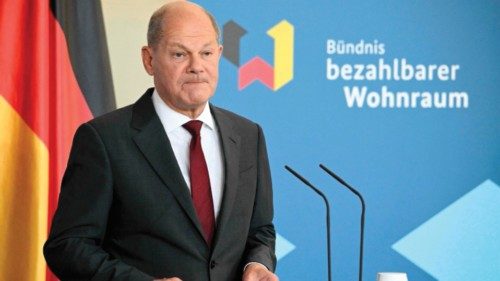
Three days after the start of the Russian full-scale invasion of Ukraine, on the 27th of February 2022, German Chancellor Olaf Scholz addresses the Bundestag. In his speech, the Chancellor outlines how the invasion marks a Zeitenwende, a turning point, in Germany and the world’s history as well as in its defense policy and relations with Russia.
Cominotto Lorenzo
The Zeitenwende speech surprised many, particularly Scholz’s own party, the Sozialdemokratische Partei Deutschlands (SPD) which has maintained friendly relations with Moscow for many years, included personal ties and lobbying by the former Chancellor Schröder.[1] The Chancellor described a historic shift in Germany’s strategy outlining its commitment to reaching the 2% NATO spending target and creating a €100billion investment plan for the Bundeswehr – the armed forces of the Federal Republic of Germany –, while delivering weapons to Ukraine. Olaf Scholz has been reluctant in taking a strong position in the months and years before the outbreak of the War, particularly given Germany’s historically tolerant relationship with the Kremlin and its reliance on cheap energy imports from Russia.
Zeitenwende was meant to be a much-needed revolution in Berlin’s approach to foreign and defense policy, a new era characterized by a strategic mentality and a renewed role within the EU and NATO. However, the change seems to fall short of his promises. While public perception transformed, Scholz’s government has been slow in adopting the changes it set for itself. Such delay is related to difficulties in abandoning previous policies, disagreements within the coalition partners on how to act, and a latent hope that a full detachment from old strategies could have been avoided.
Nevertheless, the new government and broader EU and NATO changes, such as new investments in defense and the fear for the American realignment, could give new life to the Zeitenwende project, with the hope of eventually reaching the initial goals.
Background
To clearly assess the significance of the Zeitenwende it is important to recall Germany’s recent history. The dissolution of the Wehrmacht, the armed forces of Nazi Germany, was decided in 1946, however in the worsening scenario of the ideological confrontation at the beginning of the Cold War, it soon became clear that rearming West Germany was a necessary step to defend the West from communism. The Bundeswehr was reestablished in 1955, and it was integrated in NATO’s structures, after the failure of the Pleven Plan which aimed to create a unified European Army. In this context, the reconstruction of the Heer was possible both because of the USSR threat in Europe and because it was embedded within an alliance that could prevent any revival of militaristic impulses (France’s primary concern).
Following decades of striving for reunification and the massive defense spending of the Cold War, post-1989 Germany became deeply committed to pursuing a peaceful foreign policy.
Initially, this policy was shaped by the constraints of the reunification agreement, which limited the size of the German army, as well as by the concerns of Germany’s allies – especially France and Italy – about a unified Germany. Italian Prime Minister Giulio Andreotti famously joked, <<I love Germany so much that I prefer to see two of them>>, quoting the French novelist François Mauriac.[2]
The notion of a weak Bundeswehr quickly became embedded in the national mindset. Many political parties embraced pacifism as a core part of their ideology, and non-intervention became the guiding principle of German defense policy.
Participation in NATO missions abroad faced strong domestic criticism – both in the case of the former Yugoslavia and Afghanistan – and the practical role of the German military in these operations was largely limited to intelligence gathering and the training of local police forces.
The military faced significant budget cuts, repeatedly failing to meet the 2% NATO spending target. The size of the armed forces shrank, readiness levels plummeted, and much-needed reforms to the procurement system were neglected.
In foreign policy, Berlin relied heavily on the United States for security and failed to address the growing Russian threat, even after the annexation of Crimea in 2014. Germany avoided diversifying its energy suppliers and continued to depend on cheap gas from Moscow.
It was amid this prolonged period of underinvestment, deliberate inefficiency, and overreliance on bot allies and adversaries that the full-scale invasion of Ukraine took place.
The ambitions of Zeitenwende
Olaf Scholz’s speech announced reforms in five key elements of Germany’s reaction to the Zeitenwende:
- Support for Ukraine.
- Reduction of dependency on Russian energy.
- Taking a tougher approach to Russia and authoritarian states.
- Enhancing Germany’s role and commitment to the EU and NATO.
- Increase in defense spending and modernization of the Bundeswehr.
These goals were meant to be a break with Germany’s traditional civil power identity by creating a new strategic posture and complementing its normative power with a renewed hard power. As described by Scholz: «We are living through a watershed era. And that means that the world afterwards will no longer be the same as the world before.»[3] However, without an effective strategy, Germany risks making only superficial changes, leaving itself unprepared for major political and economic challenges and undermining the trust of its allies.
Support for Ukraine
The Scholz government has failed to understand the strategic importance of supporting Kyiv. Rather than supporting the goal of winning the war and acting accordingly, the government has never stated that Ukraine should win.[4]
While Germany has distinguished itself for being the second larger donor in absolute terms and hosting a considerable number of Ukrainian refugees, expert and allies criticized Berlin’s small commitment in proportion of GDP compared to other EU states.[5] Germany is the 12th largest contributor in terms of percentage of GDP in Europe, with a total of 0.75% of GDP between bilateral and European contributions. For comparison, the baltic states directed over 2% of their GDP.[6]
Moreover, Berlin’s limited stockpiles of equipment did not really allow it to contribute significantly more to the deliveries due to low readiness level. This has meant that Germany has been really slow in providing military supplies to Ukraine and has initially blocked other countries from delivering German-made devices. However, it is plausible that some vehicles regarded as not operational by Berlin would still have been much appreciated by Kyiv, and that Germany could have provided more fund for acquisitions from third parties.
Since the Zeitenwende speech, the Scholz government has collapsed in November 2024, leading to snap elections in February 2025. The new Merz government, that has taken office last May, and the newly appointed Chancellor Friederich Merz has been much more vocal in supporting Ukraine’s ambitions and aids for Kyiv.[7] However, despite advocating for the delivery while at the opposition, it has not yet solved the dispute regarding the supply of the Taurus cruise missile to Ukraine.[8]
Reduction of dependency on Russian energy
Looking at the energy policy, some have described the diversification away from Russian gas as “the biggest success of the Zeitenwende.”[9] The same experts were nevertheless less convinced by the government’s efforts to find a geopolitically, ecologically, and economically viable energy mix.
Germany’s gas supplies from Moscow were halted in late 2022, much faster than many had thought possible. However, the ambition to end reliance on Russian gas quickly and completing at the same time the nuclear power phaseout prompted an increase in the use of high-polluting coal.
Despite improvements, Germany remains dependent on authoritarian countries for its energy – importing gas from Qatar and Azerbaijan, as well as sourcing key materials and components for its wind and solar systems from China. Additionally, reports assess that Germany still receives significant quantities of Russian LNG, even though much lower than pre-2022 levels.[10]
Read more:
Taking a tougher approach to Russia and authoritarian states
The reliance on these authoritarian states, as well as the economic dependence on China, shows the limited progress Germany has made in its task of decoupling from these regimes.
Although the quick shift away from Russian gas necessarily required new deals with other countries, the fact that the Zeitenwende policy called for a novel approach to such states made the whole policy look ineffective and hypocritical.
Both the former Scholz government and parliamentarians of the CDU did not exclude future relations with Russia, whether for an eventual return to previous forms of cooperation or for limited gas supplies.[11]
The delay in providing Ukraine with heavy military systems, along with repeated signaling of concern about a possible Russian use of nuclear weapons, was perceived by many as an inability to understand the strategic situation, as a sign of vulnerability to coercion, and as an excuse to preserve the possibility of future relations with Russia.
The slow reaction to growing Chinese economic leverage in Germany and the hampering of EU-wide decoupling efforts signaled a failure to break up with authoritarian states and a miscalculation of geopolitical risks.
Enhancing Germany’s role and commitment to the EU and NATO
During the Scholz government, Berlin was highly reluctant to confront Moscow and did not alleviate its reliance on the US, despite claiming the need for Germany to play a greater role in its alliance networks. The new Merz government, on the other hand, announced the goal of making the Bundeswehr “the strongest military in Europe,”[12] and promised to reach the 3.5 percent core defense spending target by 2029.[13]
EU-wise, collaboration with allies has been described as ineffective and uncoordinated.[14] Berlin has been seen as prioritizing domestic coalition politics and national industrial interests over constructive European collaboration and environmental goals.[15]
However, while Scholz refused to consider joint debt to fund increased defense spending, the new government managed to reform the debt brake for defense spending.[16] Additionally, the deployment of a full combat brigade to Lithuania and the European Sky Shield Initiative (ESSI) – although the latter faced criticism from France and Poland, which refused to participate – are two important positive exception in the difficult relations with allies.
Nevertheless, Germany has been accused of failing in both leading and in following the lead of others.
Increase in defense spending and modernization of the Bundeswehr
Finally, the announcement of the € 100 billion special fund for the armed forces was the centerpiece of the Zeitenwende speech. Despite uncertainty on how to finance the continuation of the trend once the special fund would have been over, the Scholz government managed to reach the 2% goal in 2024.[17] Additionally, the new government backed the 5% objective set during the NATO summit in 2025.[18]
In terms of capability, many new vehicles and weapons systems were part of older orders.[19] Although the new acquisitions surely improved the Bundeswehr’s capabilities, the current level of procurement does not match Scholz’s stated level of ambition.
The new 5% goal promises major investment in new systems; however, a larger reform of the German procurement systems is needed to translate new funds into an actual transformation of the Bundeswehr’s capabilities.
The goal of becoming “the strongest military in Europe” seems still far, obscured by the impressive growth of the Polish efforts; however, the current declarations and initiatives of the German government would have been unimaginable before the Zeitenwende.
Conclusion
In light of this analysis, it is hard to advocate that the Zeitenwende policy brought the promised results.
Long term narratives and policies, such as the unconditional reliance on Russian gas, have witnessed significant shifts. However, structural constraints and political unwillingness prevented the fulfillment of several goals.
The Scholz government met the 2% defense spending target, broke with tradition by supplying weapons to countries engaged in conflict, and diversified Germany’s energy sources, while also achieving limited collaborative successes with its allies. On the other hand, the new policy lacked a coherent and comprehensive strategy, failed to address structural problems in Germany’s procurement processes and strategic thinking, and did not satisfy Berlin’s allies.
Mixed results suggest that the Zeitenwende did not manage to deliver meaningful changes to Germany’s foreign and defense policies and that it failed to capitalize on the momentum created by the Russian full-scale invasion of Ukraine.
Scholz’s leadership was widely viewed as inadequate for the challenges Germany faced. In contrast, the new chancellor – already actively pursuing significant reforms – alongside evolving EU and NATO strategies shaped by the war and the shifting US stance under Trump, can inject fresh momentum into the Zeitenwende project.
The combined effects of the war, the U.S. realignment, the renewed European initiative, and a change in leadership might finally deliver the Zeitenwende that Germany and its allies have been waiting for.
Note
[1] Germany loses patience with ex-chancellor’s Russia lobbying, France24, 13 February 2022, https://www.france24.com/en/live-news/20220213-germany-loses-patience-with-ex-chancellor-s-russia-lobbying.
[2] Le Frasi Celebri di Andreotti, Il Sole 24 Ore, https://st.ilsole24ore.com/art/notizie/2013-05-06/talmente-tanto-germania-preferivo-153020.shtml?uuid=AbHYnXtH.
[3] Policy statement by Olaf Scholz, Chancellor of the Federal Republic of Germany and Member of the German Bundestag, 27 February 2022 in Berlin, Bundesregierung, https://www.bundesregierung.de/breg-en/service/archive/policy-statement-by-olaf-scholz-chancellor-of-the-federal-republic-of-germany-and-member-of-the-german-bundestag-27-february-2022-in-berlin-2008378.
[4] The End of the Zeitenwende?, Deutsche Gesellschaft für Auswärtige Politik (DGAP), 2024, https://dgap.org/en/research/publications/end-zeitenwende.
[5] Ibid.
[6] Ukraine Support Tracker, Kiel Institute for the World Economy, https://www.ifw-kiel.de/topics/war-against-ukraine/ukraine-support-tracker/.
[7] Ukraine Must Win, Regain Full Territory: Germany’s Merz, Barron’s, 24 January 2025, https://www.barrons.com/news/ukraine-must-win-regain-full-territory-germany-s-merz-edcf2fb4.
[8] Chancellor Merz: Taurus Missiles to Ukraine Still on the Table, but Training Not Started, UNITED24 Media, 2025, https://united24media.com/latest-news/chancellor-merz-taurus-missiles-to-ukraine-still-on-the-table-but-training-not-started-9561.
[9] The End of the Zeitenwende?, DGAP, loc. cit.
[10] German demand soars for Russian LNG via European ports, Financial Times, 28 January 2025, https://www.ft.com/content/81f60240-9f01-4dd8-85b0-1fec654a5257.
[11] Germany’s CDU: Nord Stream, Russia Gas, AfD, Far Right, Deutsche Welle (DW), 27 March 2025, https://www.dw.com/en/germany-cdu-nord-stream-russia-gas-afd-far-right/a-72060104.
[12] Germany Aims to Have ‘Strongest Military in Europe’: Merz, Deutsche Welle (DW), 14 May 2025, https://www.dw.com/en/germany-aims-to-have-strongest-military-in-europe-merz/a-72546478.
[13] Germany pledges to hit 3.5 percent defense spending target by 2029, Politico, 23 June 2025, https://www.politico.eu/article/germany-pledges-to-hit-3-5-percent-defense-spending-target-by-2029/.
[14] Germany’s Failure to Lead the EU Is Becoming a Problem, The Economist, 25 July 2024, https://www.economist.com/leaders/2024/07/25/germanys-failure-to-lead-the-eu-is-becoming-a-problem.
[15] Germany Is Letting a Domestic Squabble Pollute Europe’s Green Ambitions, The Economist, 9 March 2023, https://www.economist.com/europe/2023/03/09/germany-is-letting-a-domestic-squabble-pollute-europes-green-ambitions.
[16] Germany’s Bundestag votes in favor of reforming debt brake, Deutsche Welle (DW), 2025, https://www.dw.com/en/germanys-bundestag-votes-in-favor-of-reforming-debt-brake/live-71956815.
[17] Germany met NATO 2% defence spending target in 2024, sources say, Reuters, 20 January 2025, https://www.reuters.com/world/europe/germany-met-nato-2-defence-spending-target-2024-sources-say-2025-01-20/.
[18] Germany backs 5% NATO defense spending target, Deutsche Welle (DW), 2025, https://www.dw.com/en/germany-backs-5-nato-defense-spending-target/a-72549909.
[19] Germany Needs to Finish the Job and Think Bigger, Deutsche Gesellschaft für Auswärtige Politik (DGAP), 2024, https://dgap.org/en/research/publications/germany-needs-finish-job-and-think-bigger.
Foto copertina:Zeitenwende