War in the 21st century rarely begins with a formal declaration or columns of tanks crossing borders. Instead, it often unfolds quietly: through hacked emails, manipulated elections, energy pressure, cyberattacks on hospitals, or viral misinformation that turns societies against themselves. This phenomenon is commonly described as hybrid warfare, and it has become one of the European Union’s central security concerns.
By Ludovica Castellana
What is hybrid warfare?
Hybrid warfare refers to the coordinated use of military and non-military tools, including cyber operations, disinformation, economic coercion, political influence, sabotage, and conventional force- designed to destabilize a target without triggering a clear-cut military response.[1] Its defining feature is ambiguity.[2] Attacks are structured to remain below the threshold of open war, making retaliation politically, legally, and militarily difficult.
Why Hybrid Warfare Is Especially Dangerous Today?
Hybrid warfare is not new, but the conditions of the 21st century have made it far more potent. Digital technologies allow hostile actors to reach millions instantly, while social media amplifies emotional and divisive narratives faster than governments can respond. Modern societies are deeply interconnected and therefore vulnerable: energy grids, financial systems, communication networks, and democratic institutions are all potential targets.
Unlike conventional warfare, hybrid warfare directly exploits internal weaknesses, such as political polarization, declining trust in institutions, economic inequality, and fragmented media environments. The battlefield is not only territory, but perception. If citizens lose faith in elections, public health systems, or democratic legitimacy, the strategic goals of an adversary may be achieved without a single shot being fired.
Why the European Union Feels Particularly Exposed?
The EU’s structure makes it both resilient and fragile. While it is economically powerful, it is politically complex: 27 member states with different threat perceptions, historical experiences, and defense capabilities. Hybrid warfare thrives in such environments, exploiting disagreement and slow decision-making.
European officials frequently point to Russia as a key practitioner of hybrid tactics,[3] citing cyberattacks, election interference, energy leverage, and information campaigns in Eastern Europe and beyond.[4] From the EU’s perspective, these actions challenge not only national security but the foundations of liberal democracy itself. The fear is not necessarily of invasion, but of erosion: a gradual weakening of unity, credibility, and political coherence.
Is the EU Promoting Propaganda to Justify Confrontation With Russia?
Critics argue that the EU exaggerates the threat of hybrid warfare to justify increased militarization or a more confrontational stance toward Russia. From studies, it appears that many influence initiatives attributed to Russia’s hybrid warfare apparatus are not the product of a fully centralized or state-managed campaign, but instead reflect varied agendas, degrees of autonomy, and forms of interaction between private actors and official Kremlin institutions.[5] Hence, those who criticize the EU stance on Russian hybrid attacks view public warnings, strategic communications, and counter-disinformation campaigns resemble propaganda designed to prepare European publics for conflict.[6] [7]
On the other hand, supporters of EU policy reject this framing. They argue that acknowledging hybrid threats is not propaganda but a defensive necessity[8]. Indeed, according to this stance, the intrinsic ambiguity of hybrid threats delays an effective government response, blurs the distinction between regular and irregular forces, and makes pinpointing responsibility extremely difficult.[9] From their perspective, silence or neutrality would leave societies vulnerable; while transparency about threats strengthens resilience.[10]
The reality likely lies between these positions. Strategic communication is now an accepted tool of governance, and lines between information, persuasion, and propaganda are increasingly blurred. The EU seeks to shape public understanding of security threats, but this does not automatically equate to advocating military aggression.
A New Kind of Security Dilemma
Hybrid warfare creates a paradox: responding too weakly invites further interference, while responding too aggressively risks escalation. The EU’s challenge is to defend itself without undermining the democratic values it claims to protect.
In this sense, hybrid warfare is not only a security issue but a political one. It forces societies to confront difficult questions about free speech, sovereignty, and resilience in an age where war is not always clearly visible.
What makes hybrid warfare truly dangerous is not just the actions of external actors, but how effectively those actions exploit uncertainty, fear, and division within open societies themselves.
The European Union’s growing fixation on hybrid warfare risks is becoming a self-reinforcing narrative that blurs the line between legitimate security concerns and political storytelling. While Russia has undeniably employed hybrid tactics, the EU’s discourse increasingly frames nearly every internal disruption -energy crises, social unrest, electoral distrust- as evidence of external aggression. This framing serves a strategic purpose: it externalizes blame, strengthens internal cohesion, and normalizes exceptional security measures. Yet by doing so, the EU risks overstating the coherence and omnipotence of its adversaries while downplaying its own structural vulnerabilities. When fear becomes the primary lens through which threats are interpreted, resilience gives way to paranoia, and defensive communication begins to resemble the very propaganda the Union claims to oppose.
Note
[1] Bachmann, D., S. D., Putter, D., & Duczynski, G. (2023). Hybrid warfare and disinformation: A Ukraine war perspective. Global Policy, 14(5), 858–869. https://doi.org/10.1111/1758-5899.13257
[2] Mumford, A., & Carlucci, P. (2023). Hybrid warfare: The continuation of ambiguity by other means. European Journal of International Security, 8(2), 192–206. https://doi.org/10.1017/eis.2022.19
[3] European External Action Service. (2025). Speech by President von der Leyen at the European Parliament plenary debate on a united response to recent Russian violations of the EU Member States’ airspace and critical infrastructure. EEAS–Delegation of the European Union to Ukraine. https://www.eeas.europa.eu/delegations/ukraine/speech-president-von-der-leyen-european-parliament-plenary-debate-united-response-recent-russian_en?s=232
[4] Council of the European Union. (2025). Hybrid threats. Consilium: Policies. https://www.consilium.europa.eu/en/policies/hybrid-threats/#russia-belarus
[5] Laruelle, M., & Limonier, K. (2021). Beyond “hybrid warfare”: a digital exploration of Russia’s entrepreneurs of influence. Post-Soviet Affairs, 37(4), 318–335. https://doi.org/10.1080/1060586X.2021.1936409
[6] Rid, T. (2012). Cyber War Will Not Take Place. Journal of Strategic Studies, 35(1), 5–32. https://doi.org/10.1080/01402390.2011.608939
[7] Foerster, A. (2025). No, Recent Drone Sightings are Not Examples of Hybrid Warfare. Small Wars Journal. https://smallwarsjournal.com/2025/11/03/no-recent-drone-sightings-are-not-examples-of-hybrid-warfare/
[8] ANSA. (2025, December 17). The EU must be ready to fight a modern hybrid war: von der Leyen. ANSA – Nuova Europa. https://www.ansa.it/nuova_europa/en/news/countries/germany/2025/12/17/the-eu-must-be-ready-to-fight-a-modern-hybrid-war-von-der-leyen_ab852dd3-d6cd-495d-aad3-15d16434d678.html
[9] Mumford, A., & Carlucci, P. (2023). Hybrid warfare: The continuation of ambiguity by other means. European Journal of International Security, 8(2), 192–206. https://doi.org/10.1017/eis.2022.19
[10] Marchandise, C., McKee, M. (2025). Europe in a hybrid war: health security as strategic defence, European Journal of Public Health, 35 (6), 1074–1075. https://doi.org/10.1093/eurpub/ckaf210
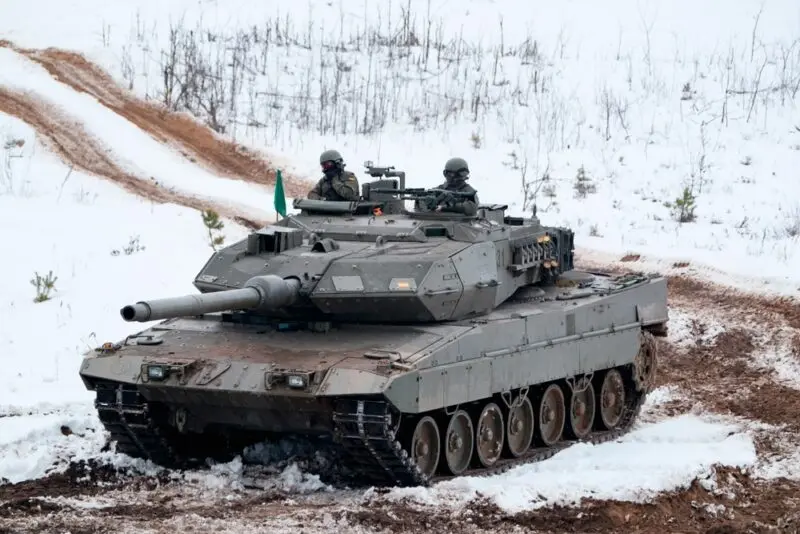
Foto copertina: Un Leopard 2 durante un’esercitazione Nato in Lettonia – © Karlis Dambrans/Shutterstock